

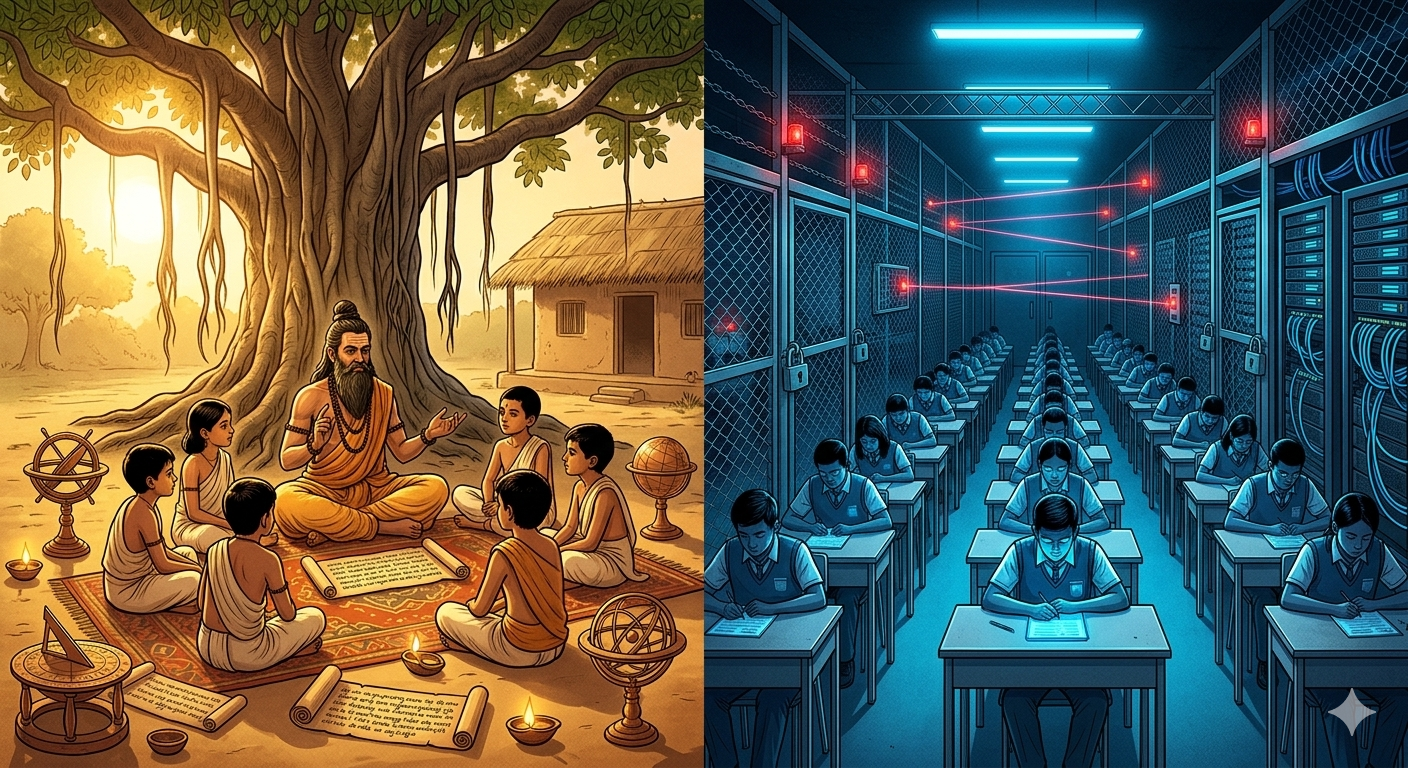
Part 1: Broken Modern Exam System
India’s competitive examination ecosystem is not a measure of intelligence; it is an elimination matrix. Every year, millions of Indian students lock themselves in 10×10 rooms in coaching hubs like Kota, trading their mental health for a fraction of a percentage point. The National Eligibility cum Entrance Test (NEET) and similar single-window entrance exams are marketed as the ultimate meritocratic equalizers. They are not. They are a multi-billion-rupee bottleneck designed to gatekeep limited state resources while filtering out students who cannot afford specialized coaching.
The Illusion of Objective Merit
When a single three-hour test decides the entire trajectory of an 18-year-old’s career, education stops being about learning and becomes entirely about pattern recognition. Entrance exams create a toxic “coaching culture” that systematically renders school education irrelevant. If a student with a 95% score in board exams still needs a multi-lakh coaching module just to decipher entrance-level multiple-choice tricks, the main curriculum has officially failed.
Why the Current Testing Infrastructure is a Scam
- The Single-Day Gamble: A single bad day, a bout of anxiety, or a minor technical error under digital marking models wipes out years of consistent academic effort.
- The Socio-Economic Filter: High-stress entrance frameworks favor students from affluent urban backgrounds who can invest heavily in parallel test-prep resources.
- The Institutional Bottleneck: We have created an artificial deficit. Instead of scaling up quality educational infrastructure to meet the demands of a massive youth demographic, the system relies on high-stakes elimination testing to hide its lack of capacity.
Part 2: The Paper Leak Underworld – 20 Years of Data Exposed
India does not suffer from occasional security lapses; it is fighting an organized examination black market. The recent cancellation and forced re-tests of nationwide examinations like NEET-UG are just the surface of a deeply institutionalized crisis. When question papers are compromised across state borders, it mocks the grit of honest candidates and leaves millions of dreams hanging in limbo.
The 20-Year Legacy of Exam Fraud
An extensive look into India’s systemic testing failures from 2005 to 2026 uncovers a staggeringly bleak reality:
- Total Documented Scams: Over 220 major examination fraud incidents have been formally recorded across 21 states.
- The Accelerated Scale: The crisis has worsened dramatically. Before 2015, the country averaged roughly 7 major leaks per year. Post-2015, that rate nearly doubled to an average of 12 documented major leaks annually due to digital vulnerabilities and highly organized underground mafias.
- The Human Toll: Over the last decade alone, these paper leaks have directly disrupted, delayed, or broken the career timelines of an estimated 7.5 crore to 10 crore young Indian aspirants.
- The Accountability Void: Out of 45 major interstate paper leak cases thoroughly investigated over the last two decades, only 2 cases resulted in judicial convictions. The perpetrators routinely exploit prolonged trials and easy bail loops.
What Kind of Papers are Leaking?
The data shows that no tier of education or employment is immune to the leak racket:
| Exam Category | Key Historical & Current Benchmarks | Impact on Aspirants |
|---|---|---|
| National Medical Entrance | 2015 AIPMT (cancelled by Supreme Court) & 2026 NEET-UG (cancelled by NTA due to pre-circulated paper leaks). | Millions of medical aspirants subjected to immense psychological exhaustion and mandatory re-tests. |
| Central Recruitment | 2017 SSC (Staff Selection Commission) leaks and systemic digital center compromises. | Year-long recruitment freezes for crucial central government administrative positions. |
| State Civil & Public Services | 2022 Bihar BPSC paper leaks, Vyapam scam, and various state-level police recruitment exams. | Total structural collapse of local youth trust in state-administered merit systems. |
| School & Teacher Eligibility | 2021 CBSE Class 10/12 leaks and the Rajasthan REET paper compromise. | Early normalization of academic corruption for high school students. |
Part 3: Reclaiming the Gurukul – The Ancient Blueprint for Modern Reform
To fix Indian education, we do not need minor administrative patches; we need a fundamental philosophical shift. Long before the British colonial pipeline turned Indian schools into factories for generating compliant clerks, the Indian subcontinent relied on the Gurukul system. Bringing back the Gurukul philosophy does not mean abandoning modern science or reverting to archaic lifestyles. It means replacing a cold, industrialized elimination model with a holistic blueprint for human growth.
Core Pillars of Ancient Indian Education Worth Bringing Back
- Skill-Based Mastery Over Memorization: In the classical Gurukul framework, education was highly personalized. Students were evaluated based on their practical competency and aptitude (Guna and Karma), not their ability to mug up a uniform booklet for a single mass elimination test.
- The Mentor-Disciple Relationship (Guru-Shishya Parampara): Modern education isolates the student behind a computer screen or inside a crowded 500-seat lecture hall. The ancient model centered on micro-learning environments where character building, emotional regulation, and ethical values were taught alongside complex sciences.
- Experiential, Applied Learning: Ancient institutions integrated philosophy, mathematics, metallurgy, and astronomy with daily life applications. Education was active, interdisciplinary, and deeply synchronized with nature—completely opposite to the indoor, sedentary test-prep factories of today.
The Realistic Blueprint for 2026
We can blend historical wisdom with 21st-century realities. We must decentralize the testing process. Instead of forcing 2 million students into a high-stakes, leak-prone single-day testing pipeline, admissions should evaluate cumulative performance over multiple years, using encrypted regional portfolios. True reform means using modern tech to revive ancient principles: small class ratios, continuous skill-based evaluation, and an absolute rejection of the idea that an individual’s worth can be summed up by a single test score sheet.
———————————————————————————————————————————————————-
What do you think? let me know in comments.!